
Finding pride in my identity as a queer bisexual Jewish woman is something I have been thinking a lot about during this year’s Pride Month, as I have realized that there is a big leap between accepting your own identity and feeling proud of it. It took me time, experience, and community to discover the sort of unbridled pride that is so important to connect to after your initial acceptance of identity. I was lucky enough to have grown up in environments that made me feel safe to explore and accept my identity, and the next step was to take my own journey in finding the pride and self-love that comes along with having that identity.
In thinking about these ideas, I was introduced to the Vivienne Cass Identity Model that described six stages of LGBT identity development while living in a societal climate of homophobia and biphobia. The fifth of these six stages is “identity pride,” which leads to the sixth stage of “identity synthesis,” a full, confident integration of sexual identity into all aspects of self. While my journey and your journey may not follow this exact model, Cass has actively noted the importance of pride and how that synthesis of pride into one’s entire identity can help you move beyond just tolerance or acceptance of identity in itself.
For me, art is what helped me connect to that identity pride and ultimate synthesis. As an art history major, learning about the iconic queer artists of the past and present gave me a certain sense of pride in the achievements of our community, an understanding of my own dignity, and a better understanding of the confidence expressed by all members of the LGBTQIA+ community. The power of finding queer-coded artworks allowed me to feel a deep bond between queer people throughout time, location, and profession.
Discovering artistic references and symbols that resonated with my own identity gave me a sense of solidarity and safety. There is a power in these artworks and these artists’ lives that I want to embody in the pride I carry forward in my own life and identity. I want to share this pride with the world, with future generations, with members of the LGBTQIA+ community, and with all our allies.
Some of the first LGBTQIA+ artists I learned about were some of the most outspoken ones as well, including artists like Keith Haring and Félix González-Torres who have both openly expressed the struggles and joys of their LGBTQIA+ identity. Haring and González-Torres have used innovative mediums and motifs in their artworks to express the feelings of love and pain faced by their community during the devastating AIDS epidemic.

Felix González-Torres, Untitled (Portrait of Ross in L.A), 1991
Both Haring’s 1989 Ignorance = Fear poster and González-Torres’ 1991 Untitled (Portrait of Ross in L.A) take activist stances to reveal to the viewer how societal and governmental responses to the AIDS crisis hurt them in undeniable ways. Haring’s pop art poster reiterates his message that “ignorance equates to fear and silence equates to death.” Interestingly, González-Torres’ artwork, while not making that same written statement, uses the symbolism of rainbow-wrapped candy to achieve a similar expression. Each day the pile of rainbow candy in the gallery is replenished to the ideal weight of a healthy male, but then visitors are encouraged to take the candy throughout the day, just as González-Torres’ lover, Ross, lost weight day after day as he fought off AIDS before his death. The artist asks viewers to viscerally understand the pain of Ross’ death, forcing them out of ignorance and silence just as Haring has encouraged us to do as well. These artists actively seek out and create allies in the viewers of their artworks.
Along my art history journey I also came across artists who were rumored to be bisexual, yet were not labeled directly because of the time in which they worked. I felt very akin to these strong female-identifying bisexual icons like Frida Kahlo and Georgia O’Keeffe, who were rumored to even have a brief romance with each other (can we say power couple). I felt like I had won the lottery when I realized how both artists have queer-coded many of their artworks in subtle and often undescribable ways, utilizing their unique perspectives on the representation of the female body to engage with their own identities as LGBTQIA+ women. Kahlo and O’Keeffe removed the ownership of female sexuality from the straight, cis, white male gaze, and have embraced it in their own ways, which pushed me to find pride in my own female sexuality.
O’Keeffe never confirmed her own sexual identity, but many viewers have noticed how her large-scale flower paintings resemble and celebrate female genitalia in a way unseen by other artists. Unfortunately, art historians are often afraid to speculate about O’Keeffe’s sexuality, likely because a “straight” identity appears to be the default assigned to most famous artists. However, letters between Fridah Kahlo and O’Keeffe hint at sexual and romantic feelings, and there is an undeniably queer presence in the motifs of O’Keeffe’s artworks. Even if the queer-coding is subtle, I still felt a certain bisexual consciousness reflected in the perception of O’Keeffe’s artworks.

Frida Kahlo, Two Nudes in the Forest (The Earth Itself), 1939
Frida Kahlo furthers those queer-coded ideas within her artworks as well. Take a look at Kahlo’s Two Nudes in the Forest (The Earth Itself), a gift for her lover, the Mexican movie star, Delores del Rio. This painting is a deeply moving depiction of love on so many levels: personal, natural, relational, emotional, and physical. While Kahlo only uses herself as the subject, there still appears to be a more intimate connection among the two versions of herself represented, possibly hinting at both self-love and her love for Delores del Rio. There is an outpouring of pride from this one image, both in Kahlo’s own dignity and the self-respect she carried for her lover.
Some artists have not queer-coded their artworks at all, but they themselves identified as LGBTQIA+ in a world and time that was unfriendly to that identity. Beauford Delaney, one of my all time favorite artists, is a prime example of this. His artworks are not explicitly queer in their symbolism or subject, but it has been noted that Delaney was an out gay man who suffered with accepting his own identity. As a gay black man growing up with a minister father, his identities were consistently criticized and erased from important spaces, and even his artworks almost disappeared from the art historical canon for some time. While some may deny his artwork as “queer,” I feel that there is something innately LGBTQIA+ about the struggle and the joy he depicts in his colorful artworks. I see Delaney paint each canvas with love and paints portraits of his dearest friends with that same joy, but in each image, especially his self portraits, there is evident discomfort and sorrow.
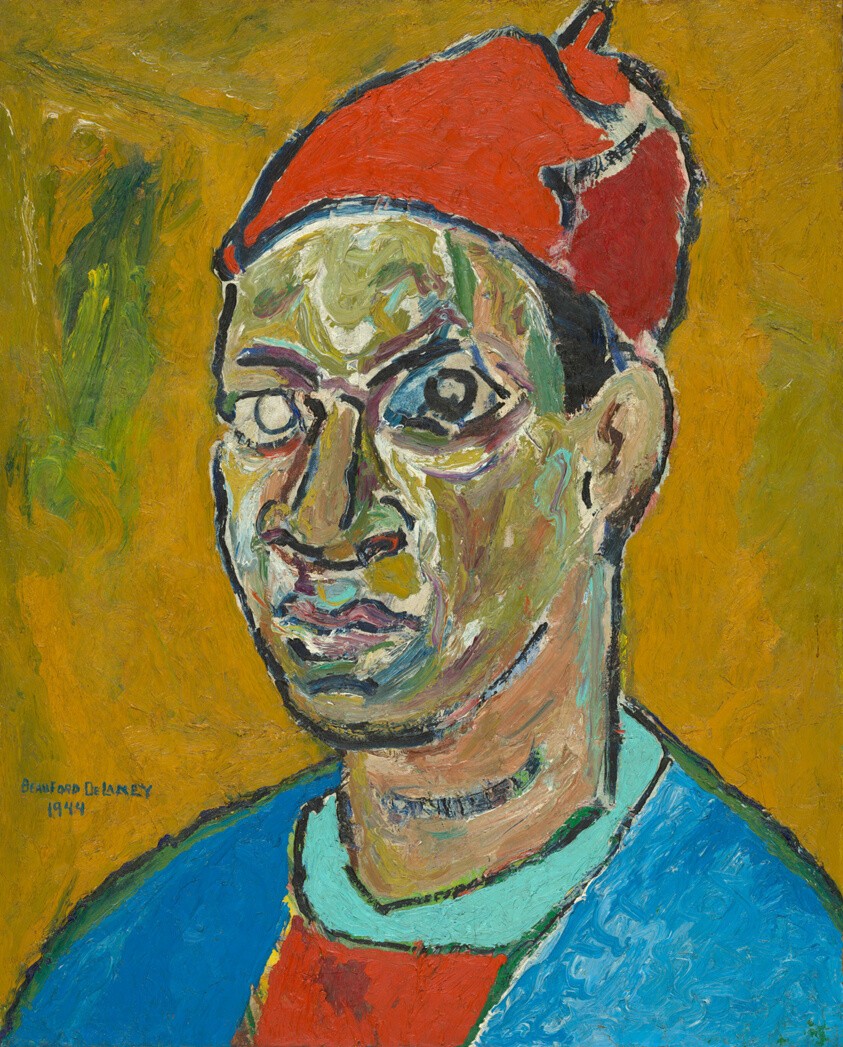
Beauford Delaney, Self Portrait, 1944
A simple glance at Delaney’s Self-Portrait, revealed to me an uneasiness in the space he occupies. His neck is delineated from his head with a deviant brush stroke and the bare canvas revealed behind the pupils of his eyes hauntingly stares back at the viewer. As I stare at the canvas I notice the colors of the artwork range from a breathtakingly joyful turquoise to a nauseating yellow-green, an emotional rollercoaster that many in the LGBTQIA+ community may relate to. I see an inherent conflict between the identities Delaney may have wanted to embrace and, at the same time, thought he had to conceal. Finding self-representation, like this narrative, displayed on the walls of a museum, can undoubtedly impact one’s pride journey.
Art history, both visually and academically engaging with LGBTQIA+ artists and queer-coded artworks, assisted me along my pride journey, my journey to the fifth and sixth stages of Cass’s Identity Model. That journey came to be an essential part of connecting to who I am and embracing my identity, even after I had been fully accepted and lovingly supported by my family and community, and that journey continues today. Finding the pride, the confidence, and the solidarity comes from seeing myself and my identity reflected; even if I never knew these artists I felt as though they knew some part of me.
For me, Pride Month is not simply about accepting one’s identity, but about finding the sense of indisputable pride and confidence that feels truest to yourself, just as these artists have done before us. Finding and embracing that pride is an ongoing and personal discovery; we can continue to seek out mediums, communities, and moments that help us find our pride along the way.
About the Author:
Zimra Chickering is an Emory University Robert W. Woodruff Scholar majoring in art history, Art Institute of Chicago Intern, and Senior Staff Writer for the Emory Wheel